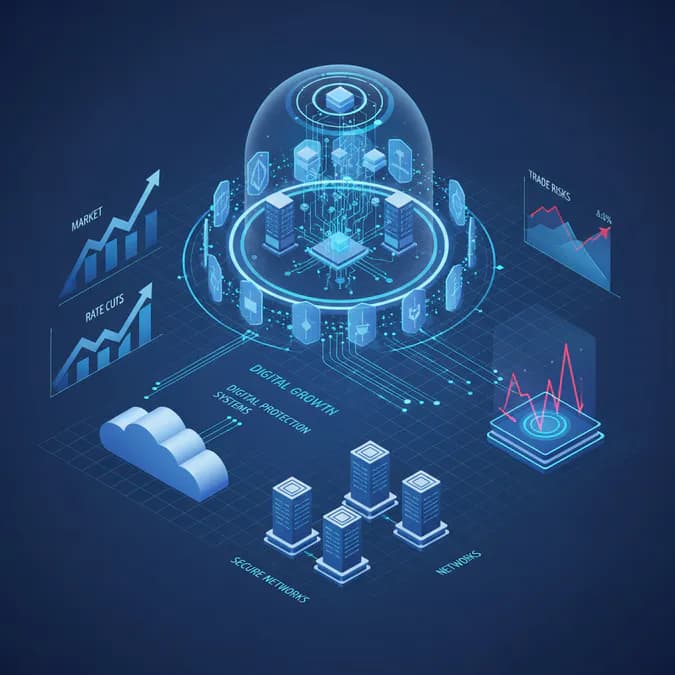
Executive Summary: 2026 Economic Outlook
The 2026 market outlook presents a compelling mix of growth opportunities and emerging risks that will shape investment decisions for the coming year. According to Bank of America Private Bank, the U.S. economy is positioned for sustained expansion driven by artificial intelligence infrastructure inves

This comprehensive outlook examines the key drivers of economic growth, the Federal Reserve's anticipated policy path, and the critical risks that could derail the positive momentum. Understanding these dynamics is essential for making informed investment decisions in 2026.
Bank of America Private Bank's analysis reveals a U.S. economy supported by five major tailwinds that collectively position the nation for continued growth throughout 2026. The forecast anticipates double-digit corporate earnings growth, moderate equity market returns, and a resilient consumer base—particularly among higher-income households and retiring baby boomers.
Chris Hyzy, Chief Investment Officer for Merrill and Bank of America Private Bank, captured the essence of this outlook: "At a time of falling interest rates and heavy investment in technology infrastructure, the U.S. economy looks poised for a new phase of growth." This sentiment reflects confidence in the structural tailwinds supporting economic expansion, even as cyclical risks require careful attention.
The economic environment differs markedly from the "stampeding bull" market phase of 2023-2025, when the S&P 500 delivered returns of 16% to 20%. While 2026 is expected to deliver more moderate but still positive equity returns, the earnings growth underlying these gains should remain robust, supported by lower interest rates and fiscal stimulus measures.
AI Infrastructure as the Primary Growth Engine
Artificial intelligence infrastructure represents the most significant structural growth driver for the 2026 economy. This extends beyond software and applications to encompass the physical infrastructure required to support AI systems: data centers, power generation facilities, and energy grid modernization.
The investment thesis is straightforward: AI deployment requires massive capital investment in computing infrastructure and electrical capacity. Companies across sectors are racing to build and upgrade data centers to support AI workloads, creating a multi-year investment cycle that will drive corporate spending, employment, and economic growth.
Hyzy emphasized the breadth of this opportunity, noting: "The key word is 'power' in every sense—from data centers and energy grids to tariff disputes, defense systems, a coming midterm election and the resilient strength of U.S. consumers and companies." This observation highlights how AI infrastructure investment intersects with energy policy, national security concerns, and geopolitical considerations.
The AI infrastructure boom creates investment opportunities across multiple sectors:
- Semiconductor manufacturers and equipment suppliers
- Electrical utilities and power generation companies
- Construction and engineering firms specializing in data center development
- Technology companies building AI systems and applications
- Materials suppliers for infrastructure construction
These investments are expected to generate sustained demand for capital goods, skilled labor, and raw materials throughout 2026 and beyond, creating a structural tailwind for economic growth that extends well beyond the technology sector itself.
Corporate Capital Expenditure Acceleration
Corporate capital expenditures are accelerating in 2026, driven by two primary factors: healthy corporate balance sheets and fiscal stimulus measures, particularly the One Big Beautiful Bill Act. This legislation provides tax clarity and creates conditions favorable for business investment by reducing uncertainty around tax policy and providing stimulus that supports corporate profitability.
The One Big Beautiful Bill Act enables corporations to self-fund capital expenditures through low-debt financing, given their strong balance sheet positions. Rather than relying on external financing, companies can deploy retained earnings and cash reserves to fund growth investments, reducing financial risk and improving return on invested capital.
Matthew Diczok, Head of Fixed Income Strategy at the Chief Investment Office of Merrill and Bank of America Private Bank, observed: "When equity prices go up faster than earnings, profits may catch up. The market could be signaling the further increase in earnings we expect to see in 2026." This dynamic suggests that corporate earnings growth will accelerate as companies deploy capital into productive assets that generate future revenue and profits.
The acceleration in corporate capex creates a virtuous cycle:
- Companies invest in new equipment, facilities, and technology
- These investments increase productive capacity and efficiency
- Higher productivity drives earnings growth
- Earnings growth supports equity valuations and shareholder returns
- Strong corporate performance encourages further investment
This cycle is expected to generate double-digit earnings growth in 2026, providing a fundamental foundation for equity market performance and supporting the broader economic expansion. The One Big Beautiful Bill Act plays a crucial role by clarifying tax treatment of capital investments and providing fiscal stimulus that enhances corporate profitability and cash generation.
Federal Reserve Policy and Rate Cut Expectations
The Federal Reserve's monetary policy stance represents a crucial tailwind for the 2026 economy. After pausing rate adjustments in early 2026, the Fed currently maintains the federal funds rate at 3.50% to 3.75%. However, Bank of America Private Bank anticipates additional rate cuts as economic growth accelerates and inflation pressures moderate.
The Fed's dovish stance reflects confidence in the economy's resilience and recognition that lower interest rates will support continued expansion. Rate cuts benefit borrowers across the economy—consumers, businesses, and governments—by reducing debt service costs and improving the present value of future cash flows.
For investors, falling interest rates create multiple positive dynamics:
- Lower discount rates increase the present value of corporate earnings
- Reduced borrowing costs improve corporate profitability
- Lower mortgage rates support housing demand and consumer wealth
- Bond valuations improve as yields decline
- Equity valuations expand as the cost of capital decreases
The anticipated rate cuts are expected to support what Bank of America Private Bank characterizes as a "proud bull market" driven by earnings growth rather than multiple expansion. This distinction is important: earnings-driven gains are more sustainable than valuation-driven gains because they reflect genuine improvements in corporate profitability rather than market sentiment shifts.
Trade Tensions and Tariff Risks
While the 2026 market outlook is generally positive, significant downside risks warrant careful attention. Trade tensions, particularly between the United States and China, pose a material threat to economic growth and corporate profitability. Tariff disputes can disrupt supply chains, increase input costs, and reduce consumer purchasing power.
The tariff environment presents several specific risks:
- Increased costs for imported goods and materials
- Supply chain disruptions affecting manufacturing and retail
- Retaliatory tariffs harming U.S. exporters
- Uncertainty around trade policy creating business investment hesitation
- Potential inflation from tariff-driven cost increases
These risks are not merely theoretical. Tariffs directly increase costs for businesses and consumers, potentially offsetting the benefits of lower interest rates and fiscal stimulus. The uncertainty surrounding trade policy can also discourage corporate investment, as companies hesitate to commit capital when future tariff regimes remain unclear.
Additional risks to monitor include:
- Sticky inflation that resists Fed rate cuts
- Potential AI investment bubbles if valuations become disconnected from fundamentals
- Geopolitical events, including midterm elections and international tensions
- Industrial geopolitics emphasizing defense and technology competition
Investors should maintain awareness of trade policy developments and adjust portfolio positioning accordingly, particularly for companies with significant exposure to tariff-sensitive sectors or international supply chains.
Investment Implications for 2026
The 2026 market outlook suggests several strategic implications for investors navigating the economic landscape:
Equity Market Positioning
The earnings-driven bull market supports equity exposure, but investors should focus on companies positioned to benefit from AI infrastructure investment and corporate capex acceleration. Technology, industrials, and energy sectors may offer attractive opportunities as companies invest heavily in infrastructure and productive capacity.
Fixed Income Strategy
Falling interest rates should support bond valuations, particularly for longer-duration securities. However, sticky inflation risks warrant careful credit analysis and consideration of inflation-protected securities to preserve purchasing power.
Sector Rotation
The emphasis on AI infrastructure and industrial investment suggests overweighting technology, industrials, and utilities while potentially underweighting consumer discretionary sectors vulnerable to tariff impacts. Companies directly benefiting from infrastructure spending and AI deployment should see stronger earnings growth.
Geographic Diversification
Emerging markets may benefit from global growth alignment and a softer U.S. dollar, providing diversification benefits and exposure to growth in developing economies. A weakening dollar also aids U.S. exporters, supporting earnings for multinational corporations.
Risk Management
Given tariff and geopolitical risks, investors should maintain adequate portfolio diversification and consider hedging strategies for companies with significant trade exposure. Stress-testing portfolios against tariff scenarios and geopolitical disruptions can help identify vulnerabilities.
Key Takeaways
The 2026 market outlook from Bank of America Private Bank presents a compelling case for continued U.S. growth, supported by AI infrastructure investment, corporate capital expenditure acceleration, and accommodative Federal Reserve policy. These structural tailwinds should drive double-digit earnings growth and support equity market performance throughout the year.
Higher-income households, which drive more than 50% of consumer spending according to the Bank of America Institute, are expected to remain resilient, boosted by investment gains and home values. This consumer strength, combined with corporate investment and fiscal stimulus, creates a favorable backdrop for economic expansion.
However, investors must remain vigilant regarding trade tensions, tariff risks, and geopolitical uncertainties that could derail this positive momentum. A balanced approach—maintaining equity exposure while carefully managing risk through diversification and sector selection—appears most appropriate for navigating the 2026 investment landscape.
The key to success in 2026 will be understanding which sectors and companies are best positioned to benefit from the identified growth drivers while remaining alert to emerging risks. By maintaining this balanced perspective, investors can position their portfolios to capture the upside potential while protecting against downside scenarios. The earnings-driven bull market offers genuine opportunities for wealth creation, but only for those who approach 2026 with both optimism and prudent risk management.
FAQs
What is the focus of the 2026 market outlook?
The 2026 market outlook focuses on AI growth, Federal Reserve rate cuts, and trade risks that could impact investment strategies.
How will AI infrastructure impact the economy in 2026?
AI infrastructure is expected to drive significant economic growth by requiring substantial investments in technology and physical infrastructure.
What are the risks associated with trade tensions?
Trade tensions can lead to increased costs, supply chain disruptions, and reduced consumer purchasing power, which may negatively affect corporate profitability.
What investment strategies are recommended for 2026?
Investors should focus on sectors benefiting from AI infrastructure and corporate capex, while also managing risks through diversification and sector rotation.
Sources
- Automated Pipeline
- 2026 U.S. Economy and Markets Outlook: Key Trends and Themes
- 2026 Market Outlook: Geopolitical Risks and Economic Trends
- Capital Market Outlook - Bank of America Private Bank March 16, 2026
- Federal Reserve Holds Rates Steady at 3.50%-3.75%
- Source: privatebank.bankofamerica.com
- Source: privatebank.bankofamerica.com
- Source: pbig.ml.com
- Source: privatebank.bankofamerica.com
- Source: privatebank.bankofamerica.com
- Source: privatebank.bankofamerica.com